
Holy Trinity Church of England Primary School
Spirituality
Schools approach Spiritual Development in many ways; we want to encourage variety and diversity in how staff at Holy Trinity help Spirituality to be a prominent part of our practice.
Our vision influences the ethos of our school and the policies and practices within it. We believe that spirituality is a core thread that runs through our school and we attach great importance to it for both children’s development and for the growth and well-being of all within our school community.
A reminder of our school's vision:
At Holy Trinity we are passionate about growing tomorrow’s leaders. We educate and equip our children with the skills they need to succeed and thrive.
We develop and value the characteristics of everyone, enabling them to flourish into the best version of themselves and be happy. We work as a community to create opportunities for all children to become confident and respectful citizens, who contribute positively to society.
We flourish when we help others flourish.
(Jeremiah 29:4-7)
Defining Spirituality:
At Holy Trinity CEP School, we define Spirituality as being something we may not be able to see, but as something we feel inside ourselves.
We feel spirituality is something that touches us all, no matter our beliefs. It is a connection to something that is bigger than us and a sense of enjoyment and fascination in learning about ourselves, others and the world around us.
Teaching and Learning:
Opportunities to explore spiritual development generally, are not planned, they occur naturally in everyday life, however we do recognise that time within the school day can be set aside to help provide opportunities for members of our school community to reflect, be still, process and simply think, especially in the early stages of our journey with establishing Spirituality at our school.
Members of the school community make a conscious effort to stop and recognise / name moments of awe and wonder that we encounter, as well as our ‘ow’ and ‘wow’ moments. This helps with the need to become aware of the world in all its wonder but also a sad realisation of its many problems. To realise that the world is both ‘awe-full’ but also sadly ‘awful’ at times too; to be aware of both its ‘wows’ but also its ‘ows,’ can be very beneficial in helping us to be spiritual. To assist us with this, we use the windows, mirrors and doors approach to spirituality.
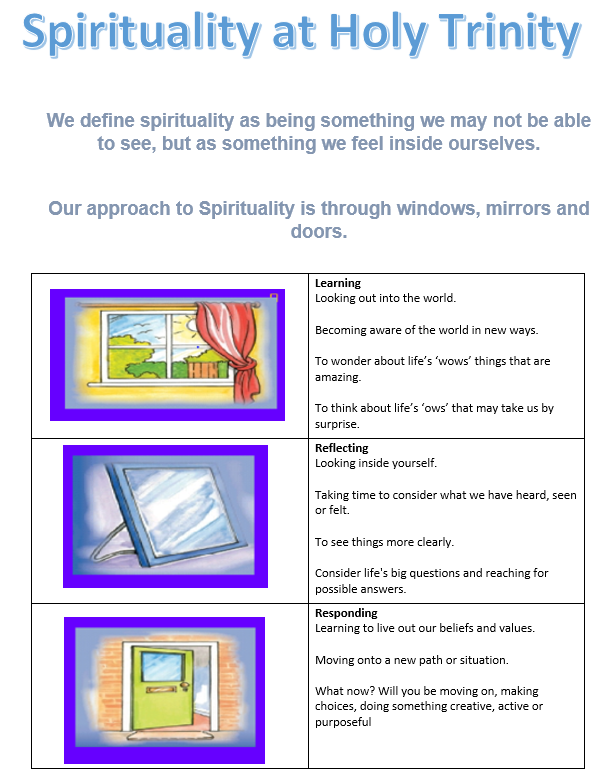
Facilitating Spiritual Flourishing:
Some further examples of our approach to facilitate Spiritual Flourishing include:
The Singing Bowl – Each class has a singing bowl that is rung to mark moments of quiet time, periods of reflection, moments of stillness. This is also used in Worship time.
Stilling – Very similar to mindfulness, Stilling is an activity which offers children and young people a variety of techniques and exercises through which to acknowledge, explore and develop the spiritual dimension of their lives. This involves teaching pupils to be ‘still,’ some see this as a way to prepare for learning and being able to focus. Sometimes a series of guided imagery reflections are used to enhance learning across a range of curriculum subjects.
Questioning – A fundamental part of spirituality is the questioning of life, purpose and the meaning of things. We need to find ways of helping children to ask such philosophical questions as they may ask. The more opportunities they have to ask such questions, the way in which those questions are responded to, and the positive reinforcement given by us as adults when such questions are asked, will extend and enhance children’s questioning of their world and thus promote their spiritual growth and journeying. We are all too often expected to know the right answers! But the one thing we must try not to do in relation to philosophical exploration is to ‘give’ the answer. Such an approach may close down the pupil’s thinking journey and spiritual development.
Wellbeing - It is now recognised by many, that spirituality can make a significant, positive contribution not only to our mental health but also to our physical health and wellbeing. Good mental health enables us to learn, feel, express and manage a range of positive and negative emotions, to form and maintain good relationships with others (and ourselves) to cope with and manage change and uncertainty and to develop resilience. At Holy Trinity, we do not just emphasise the physical aspects of being heathy, we recognise the equally important role played by mental wellbeing in the lives of children all ages. We have wellbeing clubs that pupils can attend, adults designated to completing wellbeing check ins on pupils and a mental health check in that all classes complete each day.
Spiritual Development:
At Holy Trinity CEP School, our motto is to, ‘Growing Tomorrow’s Leaders,’ which we entwine with the understanding that Spiritual Development is a life-long experience in which we grow together.
At Holy Trinity, we believe Spiritual Development is:
- Found in many faiths and cultures.
- Something that should influence all areas of education as it does all areas of life.
- Important for human flourishing and the human soul.
- Part of the universal search for personal identity.
- To do with the search for meaning and purpose in life and the values by which to live.
- Not necessarily experienced through matters visible but also through matters invisible.
- To do with relationships with others: people plants and planet and for people of faith, relationships with God.
- Something that supports our responses to challenging experiences, such as death, suffering, beauty and encounters with good and bad.
- Identifiable when pupils flourish in their learning and understanding of life.
Please see more information about Spirituality in our school in our policy below:
Parents and Children's Spiritual development: A Faith in the Nexus Animation
This Faith in the Nexus animation for parents recognises that all children have a spiritual life that drives them to seek meaning and purpose in life. Often in this search, children turn to their parents with big questions about things such as the origin of life, the existence of God, and life after death. We acknowledge that being confronted with such questions can be daunting for parents and can leave them feeling inadequate to offer a response. Thus, the main message through the animation is one of reassurance and encouragement. Parents are in a unique position to stand alongside their child and explore with them. To just "be" with your child, to share the journey of discovery and curiosity with them is powerful, and offers an experience that will encourage your child to be spiritually curious, setting the foundations for them to grow stronger in their spiritual life.